Jan 1, 2016

Happy New Year !

Happy New Year. May God bless you all throughout the year 2016.

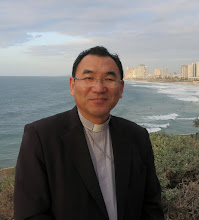
Bishop Isao Kikuchi, SVD
Catholic Diocese of Niigata, Japan


Dec 28, 2015

The people who walked in darkness have seen a great light.


Homily of the midnight Mass on the Solemnity of the Nativity of the Lord at Niigata Cathedral.

My dear brothers and sisters,
Merry Christmas.

Year after year, We gather together in this Cathedral in the evening of 24 December to celebrate the birth of our Lord Jesus. Yes, we also gather again during the daytime on 25th to celebrate the Christmas, however, the most important moment for the celebration of Christmas is in this evening celebration. We all know that nowadays majority of people in Japan celebrates Christmas even among non-Christians in the evening on 24th and that is really fitting for the celebration even though they do not realize the real meaning of it. Let me explain it.

As we see from the Gospel reading this evening, the birth of Jesus took place during the night. It said that "there were shepherds in that region living in the fields and keeping the night watch over their flock" However, repeating what is written in the Gospel is not the reason of what I am talking about.

The Gospel continues as follows; "the angel of the Lord appeared to them
and the glory of the Lord shone around them." So it was light. It was bright light shinning in the darkness. It was the bright light which struck shepherds with great fear.

In the first reading, prophet Isiah wrote "the people who walked in darkness have seen a great light; upon those who dwelt in the land of gloom a light has shone"

Who are these "people who walk in darkness" or "who dwell in the land of gloom"?

Few months after the massive earthquake and tsunami which hit Tohoku in 2011, I visited the disaster hit area. Toward evening, as there were no electricity in the area, darkness prevailed. There were no house lights nor street lights. Only darkness prevailed. While standing in the midst of this darkness, I started feel uneasiness, anxiety or even fear. I was sure that darkness produced negative energy for those evacuated in the shelters, negative energy which easily destroy people's hope for the future. Negative effects of darkness were what I felt physically that night.


What kind of reality are we living in today? Fear for terrorism. No one knows what will happen next and where that might take place. Uneasiness, anxiety and fear prevail in this world today. In Japan, we are not able to expect bright future with economic development anymore. The reality of fewer kids and aging society makes us wonder about our future. Uneasiness, anxiety and fear prevail. On an global scale, climate change has been affecting so many people severely especially in so-called under-developed countries but also us in the so-called developed countries and no one knows clear future of our common house, the earth. Uneasiness, anxiety and fear prevail. We are, therefore, the "people who walk in darkness", aren't we? We are, therefore, the people "who dwell in the land of gloom", aren't we? Many of us are increasingly dominated by uneasiness, anxiety and fear caused by inability to see clear future because we are in deep darkness.

Some months after the first visit to the disaster hit area, I again made another visit to the same town for Caritas meeting. We met in a former hotel building which survived the tsunami and had been used as Caritas Volunteer center. As we finished the meeting, I got out of the building only to be amazed by the sight. The building was a shining tower in the midst of deep darkness. Electricity was provided by a generator in the building and the town did not have electricity yet.

If it were in ordinary town, the light of this tinny hotel was nothing more than one of many lights in the town. Or even, no one would have noticed that there were lights in this building. Just a part of ordinary scenery of the town in the night. However, because of prevailing deep darkness, such ordinary and small light was shining through like the beacon of bright hope, defeating all the uneasiness, anxiety and fear of the people. The small light of the building became the source of hope for many.


Jesus was born as small baby. Hope for whole humankind was just a small light in darkness. That is the reason why the Church celebrate Christmas in darkness in the night. That is the reason why we, just before we started the Mass, had small candle for each one of us in the darkness of this chapel so that we may feel brightness of such a small candle lights. Even small lights can shine through to brighten people's heart in deep darkness. What we need is this small light of hope in all our hearts to overcome darkness of uneasiness, anxiety and fear.


We are in the Jubilee Year of Mercy now. People living in darkness with uneasiness, anxiety and fear are tend to live in mutual distrust. How can people trust each other while they are not sure about tomorrow's fate? I feel that the mutual distrust may results judgmental tendency among us. Good or bad? Friend or foe? Yes or No? As we are pressed to make judgment in order to be relieved from anxiety and fear, we tend to jump to conclusion. That is the reason why we tend to be judgmental and easily label others that they are good or bad. Generosity, tolerance and joy have no space to survive in such a society. Mercy is forgotten.

We find, these days, in internet and TV shows the heartwarming stories quite often. Why do we love to know these heartwarming stories? Why people love to watch such TV shows? Because, in reality, heartwarming experiences are missing. In the judgmental society, generosity, tolerance and joy disappear and we are hungry for story of love and mercy. Today's world needs mercy of God much more than before to escape from captivity of darkness.

For all of us living in the darkness of uneasiness, anxiety and fear, light has been given. The light is Jesus, the new born baby, who is mercy of God, who is love of God. Mercy and love of God is what we need to light our small candle, candle which brings generosity, tolerance and joy to the world.  


Dec 14, 2015

Opening of the Door of Mercy at the Niigata Cathedral


The extraordinary jubilee year of Mercy has started on 8 December and will conclude on 20 November, 2016. In Niigata Cathedral, beginning of the Jubilee Year was celebrated with Holy Eucharist with number of priests and faithful attended at 11 am on 8 December. Before the Jubilee was announced, diocese had planned a day of Advent recollection for priests on 7 December. Since number of priests who are usually scattered around the diocese were gathering together for the recollection, we decided to organize opening Mass on 8 Dec. so that faithful might feel unity of the Church by being with several priests and bishop for this special occasion. 18 Priests and more than 60 people joined the Mass.


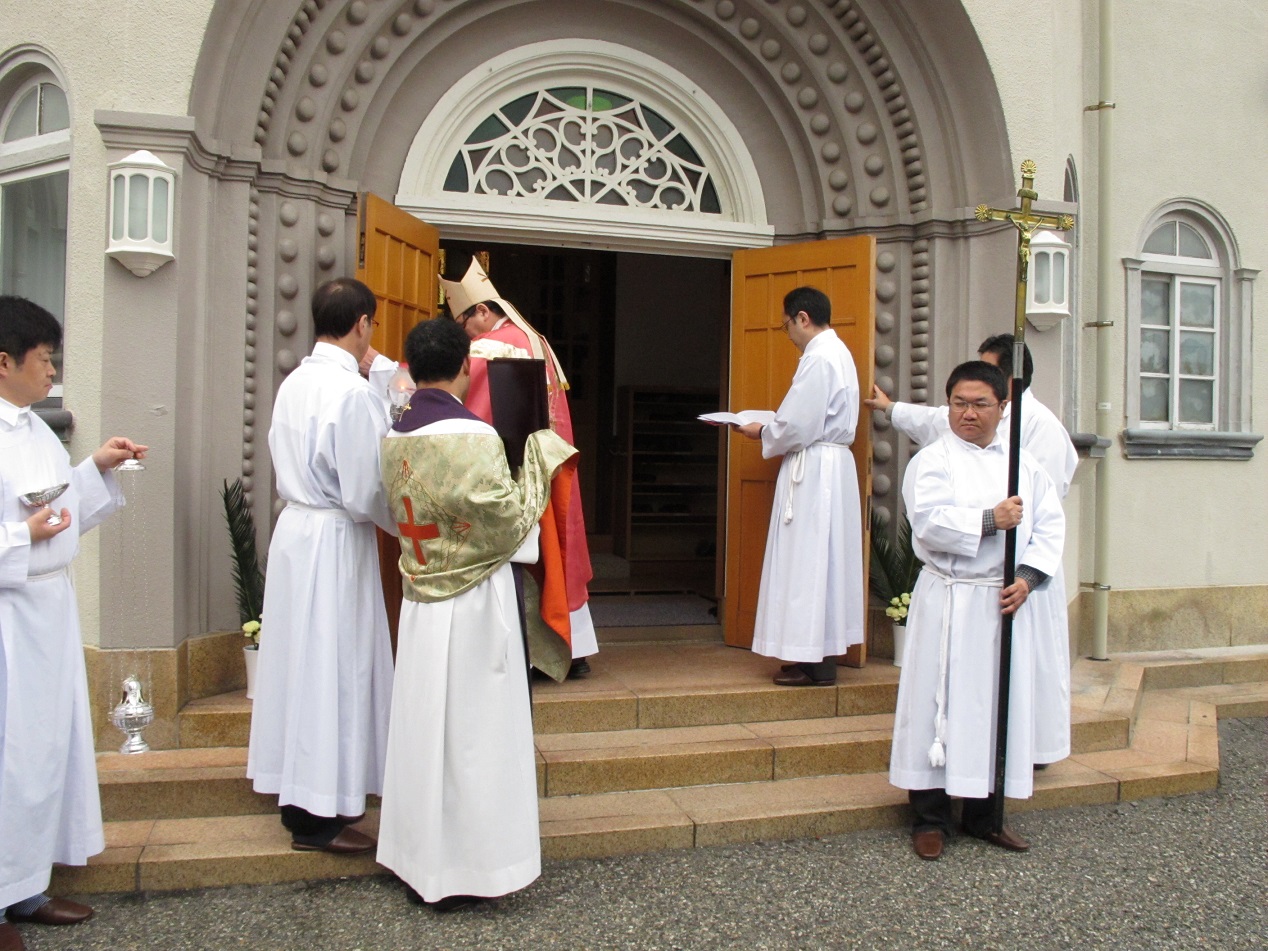
Then on 13 December, Sunday, Mass for opening of the Door of Mercy was celebrated at the Cathedral with more than 120 people. (Photos) I presided the Mass joined by Fr.Ngaji, SVD, assistant parish priest and Fr.Itagaki from Sendai diocese who was with us as a retreat preacher for the parish advent recollection.


We started the Mass from the Parish Hall and made procession to the main gate of the Cathedral which is designated as the Door of Mercy. There are all together 4 Door of Mercy in the diocese, namely Cathedral, Takada parish, Yamagata parish and Akita parish. You are invited during this jubilee year to make a pilgrimage to one of these Door of Mercy in the diocese, enter to the church through the door, go to confession, attend the Mass, receive communion and pray for the intention of Holy Father with special prayer of the jubilee composed by Holy Father himself in order to receive indulgence.


Mercy is needed in today's world more than before where people are living in darkness created by mistrust among each other. Darkness prevails particularly at the time when world security has been challenged by terror or threat of terrorism which, in many cases, produce invisible accumulation of fear. When we don't trust each other then we begin to judge each other. What a judgemental society we are living today. At home in Japan, we have to look around ourselves. Are we not talking about military threat from our neighboring countries as everyday talk? In the country where the phrase "War on Terror" has become so familiar with daily life,such as so in Japan today, it is quite difficult to talk with reason that the retaliation with force only promotes vicious circle of violence. People overtaken by fear have no ear to listen to such admonition. Feeling of mistrust and intolerance prevails in darkness today.


Meanwhile we have to think about what is the main force pushing this country, Japan, to maneuver through global village in modern days. Economy gain? Military ambition? Where is our moral principle? Country which has so-called Peace Constitution should have the leading voice with moral principle to persuade people to come out from darkness of mistrust to create real peace in this world.

But what is the reality? Are we not choosing the way to go deeper into darkness? We need to feel Mercy of God. We need to feel that God unconditionally encompass all of us, no exception, with his Mercy because he loves all of us. Church is, through this jubilee year, trying to be a beacon of hope shinning in this darkness to invite people to be filled by God's Mercy and love. Here in the Church, everyone should find consolation and joy of forgiveness so that we may be able to console each other and share our joy to escape from the darkness of mistrust. "As the Father loves, so do his children. Just as he is merciful, so we are called to be merciful to each other.(Misericordiae Vultus 9)"

Holy Father also invites all of us to be witness of Mercy of God as he wrote; "the Church’s first truth is the love of Christ. The Church makes herself a servant of this love and mediates it to all people: a love that forgives and expresses itself in the gift of oneself. Consequently, wherever the Church is present, the mercy of the Father must be evident. In our parishes, communities, associations and movements, in a word, wherever there are Christians, everyone should find an oasis of mercy.(Misericordiae Vultus 12)"

So throughout the Jubilee year, we have to try to be witness of Mercy of God through our own words and deeds and also action of our parishes and groups. Then what can we do in this diocese? This is quite a challenge for all of us in this diocese where no particular crisis are happening as such. If we are directly involved in natural disasters or war or refugee crisis or starvation or draught, etc, it would be clear for all of us that what action we should take. But these are, fortunately, not in our case. Then we have to seriously think how we could be witness of Mercy of God or "an oasis of mercy" in this situation? Perhaps, we should better broaden our perspective a bit more. Holy Father wrote as follows; "in this Holy Year, we look forward to the experience of opening our hearts to those living on the outermost fringes of society: fringes which modern society itself creates. How many uncertain and painful situations there are in the world today! (Miseridordiae Vultus 15)" Yes, the today's world is waiting for our action.


Nov 20, 2015

Have courage to stop vicious circle of violence !

It is so sad to witness again and again such brutal ends of so many innocent lives such as what happened in Paris recently. As we, Catholics, believe that human life is the most precious gift from God, we do not agree with any justification on the cause of such violent attacks over human life.

As Holy Father said, "there is no religious or human justification for it. This is not human" Well, retaliation by violence against violence may produce a kind of solution. However this solution would be only for short term or temporary.  Of course, in order to execute huge violence such as the recent Paris terrorist attacks, financial resources, organisational structure and man-power are indispensable. Therefore as long as retaliation by force could minimise such resources, then violence attacks might be ceased. But that would be a kind of supportive measures and could not touch the real cause of violence. Real cause of such brutal violence exists in our hearts, in our emotions. Armed power cannot control emotional hatred rooted deep in our hearts.

I hope this sad incident in Paris would not increase our hatred against specific group of people, or not make general public to vow to retaliate with violence, but to make people realise that taking away human life in any case with any reason is against will of our God , creator of all who granted us with this precious gift of human life.


During the Justice and Peace National Convention in Tokyo in September, I had an opportunity to share my thoughts on Peace together with Bishop Katsuya of Sapporo who is in charge of the commission for Justice and Peace.  During the talk, I mentioned that the Integral Human Development is the key for establishing real Peace, and thus Caritas activities is, in fact, action for Peace. Of course I mean Peace in a meaning specified in the VatII's Gaudium st Spes as follows.

"Peace is not merely the absence of war; nor can it be reduced solely to the maintenance of a balance of power between enemies; nor is it brought about by dictatorship. Instead, it is rightly and appropriately called an enterprise of justice. Peace results from that order structured into human society by its divine Founder, and actualized by men as they thirst after ever greater justice" (78)
(Photo below: During the national convention of Justice and Peace in Tokyo Cathedral in September. From right to left, Bp.Katsuya, Bp.Matsuura and myself)


In order to realise the "order structured into human society by its divine Founder", Pope John XXIII pointed out that number of basic human rights have to be respected and realised in the society. (Pacem in Terris) And that is the base of my point that integral human development is the must for real peace. Meaning of integral human development here is not restricted to common meaning or usage in development as such. Pope John Paul II once wrote in the Centesimus Annus" 29 as follows.

"Development must not be understood solely in economic terms, but in a way that is fully human. It is not only a question of raising all peoples to the level currently enjoyed by the richest countries, but rather of building up a more decent life through united labour, of concretely enhancing every individual's dignity and creativity, as well as his capacity to respond to his personal vocation, and thus to God's call."

I hope we have courage to face reality to stop these vicious circle of violence not by violent retaliation but by real process of creating Peace through integral human development. Unfortunately recent political initiatives by ruling Liberal Democratic Party in Japan for shifting the national security policy from passive defence to more active defense, which the prime minister named as proactive contiribution for peace, may not actually contribute to stop these vicous circle of violence.


Aug 9, 2015

Memorial day service in Hiroshima, 6 August


Almost all the Japanese Catholic Bishops and all the Japanese Anglican Bishops prayed together on the eve of the day of bombing of Hiroshima at the Catholic Cathedral of Hiroshima. It was the first time for both Catholic and Anglican bishops organised such prayer service to pray for the World Peace, Peace without nuclear weapons. Around 5 pm on 5 August, all the Bishops joined group of laity of both congregations, mainly youths, in front of the memorial tower in the Peace park. From there, all marched to the Catholic Cathedral for 40 minutes singing Japanese Christian song, "Amen, Hallelujah"


At 7 pm, ecumenical prayer service started with all the Bishops together with representatives from the World Council of Churches led by its vice moderator, Bishop Mary Ann Swenson of Methodist Church. Also present with us were 3 Tibetan Buddhist monks who, during the service, prayed for Peace with words by Dalai Lama XIV, "Words of Truth". Peace message was delivered by Bishop Swenson. Bishop Oscar Cantu, the chairman of the Committee on International Justice and Peace of United States Bishops, and Bishop Mario Iceta, Bishop of Bilbao, Spain also joined the prayer together with Archbishop Chennoth, Apostolic Nuncio. The Cathedral was full of people to pray for peace and it was quite significant occasion to see people from different denominations were united in just one cause, to establish real peace in this world.


Next morning Requiem Mass was said by Catholic Bishops presided by Archbishop Maeda of Osaka, previous bishop of Hiroshima till last year. (At this moment the see of Hiroshima is vacant.) Mass began at 8:15 am on 6 August, exact time of bombing, with ringing of bells of the Cathedral to join other bells of temples in the city.

70 years has passed since humanity saw such a great scale of man-made catastrophe Only with one single bomb, a city with four hundred thousand people was destroyed and more than ninety thousand lives vanished at once. Because of radiation related diseases more than one hundred and forty thousand people died before the end of that year.


No one actually knows why the US government decided to use two atomic bombs over Japan at the end of the WWII. Yes, it is widely believed that these two bombs over Hiroshima and Nagasaki expedited Japanese government to decide to surrender so that many lives of soldiers were saved. Maybe so. It is also said that as Japan was already losing most of its military capability at that moment in August, 1945, and its surrender was just a matter of time, two bombs were used to establish military superiority over Soviet Union in consideration of the new world order after the WWII.

I have no idea why they were used at that moment but what I know is so many lives were taken away so violently and inhumanly and so many people are still in agony, both physically and psychologically, and so many sad stories of each individuals, not only in Japan but also in other countries, were created. Justice was done? I do not know and I am not at the position to judge the history. I say the same as St.Pope John Paul II said in Hiroshima in 1981, "War is the work of man. War is destruction of human life. War is death."


What we learned from our recent experience during March 11, 2011 disaster in Tohoku is that human wisdom has clear limitations. Through our experiences of the disaster of earthquake and Tsunami, including aftermath of the accidents of the Fukushima Nuclear Power Plant for which uncertainty still prevails after more than 4 years, we found out that we had been made to believe with false sense of confidence in our own human abilities and human wisdom. We thought science is almost almighty to solve any problem in this world. It was just a dream.

Also many of us found out we had lost sense of transcendent or sense of God who is far bigger than human being. This would be the result of terrible secularization in Japanese society. We thought that human being are able to control everything in this world with our technology and in such situation, God was no more needed.

"Pride leads to destruction, and arrogance to downfall (Proverb 16:18)." This disaster has been giving us warning that each one of us have to be humble enough to examine our life style and change our attitude from self pride to humility and obedience in front of power of God. And more over, we should know that we have limitations and science is not almighty.

I believe that nuclear technology, for both military and peaceful use, is still not under control of human knowledge. As for military purpose, no one knows what will happen if all the existing nuclear arms were really put in use. No one knows because it is almost impossible to imagine the end of human existence. But knowing the capability of extinction of ourselves by nuclear arms, those who have them plenty can not take initiative to abolish them because of fear against the other side. And still some others are trying to possess them in the name of preventive measures and self defense. Alas, what Pope St.John XXIIII wrote in the "Pacem in Terris" in 1963 are not taken seriously yet. Can't we stop these? Can't we stop thinking about existence of own countries alone but to make paradigm shift to think globally? We can not maintain our lives without support from others.. As in the Book of Genesis, 2:18, the Lord God said, “It is not good for the man to be alone. I will make a helper suitable for him.” We are created to be a helper for others so without supporting each other, we lose our very reason to exist.

As for peaceful use of nuclear energy, it is complicated matter. You might think what has been happening in Japan and Fukushima in particular is quite peculiar to the earthquake prone country. I do agree that nuclear energy is clean energy and might be useful to contribute to fight against environmental degradation. But at least this technology produces nuclear waste and human knowledge at this moment has no solution to manage them other than keeping them safe, probably under ground, for quite long period of time. We are surely leaving these nuclear waste for next several generations hoping that they may find better solution. I think this has a bit of unethical implication, at least for my faith.

Are we, human race in early 21 century, really ready to responsibly utilize nuclear energy or are we trying to close our eyes not to see our limitation?


. 
 

Jul 28, 2015

Time to contemplate and act for Peace.


Summer, especially in month of August, is the time to contemplate and act for peace in Japan. In 1945, on 6 August, Hiroshima was hit by the very first atomic bomb which was followed by Nagasaki on 9 August. Then on 15 August, Japan accepted unconditional surrender to allied forces which was the end of the WWII. So the Catholic Church in Japan decided in 1981 after the Hiroshima Peace appeal by Pope John Paul II, to designate this 10-day period, starting from 6 to 15 August, as a special 10 days to pray for peace.

This year, as we commemorate 70th anniversary of the end of the WWII, all the Japanese Catholic Bishops together with all Japanese Anglican Bishops gather together at Hiroshima on 5 August to pray together for peace at the Catholic Cathedral of Hiroshima in the evening.

Each diocese organizes their own Peace activities based on respective conditions. Niigata diocese usually organizes these activities on the last Sunday of July. This year it was on 26 July at the Niigata Cathedral.


As for this year's program, we invited Mr. and Ms. Katagiri, non-Christian couple from Niigata, who have been supporting education of indigenous kids in Eastern India. They have decided to establish a local  NGO in Niigata to cooperate with Indian local NGO to support education of kids and establish a boarding school for street kids. What surprised us is that they have started this activities after retirement from their jobs. It was inspiring to hear their experience and, also, future plan.

After the talk, I said Mass for Peace in the Cathedral. Unfortunately, it was terribly hot on the Sunday and not so many people could come to join us. However, there were more than 30 people to pray together for peace in the Cathedral.

Present Japanese government led by Mr. Shinzo Abe of the Liberal Democratic Party, LDP, has been trying to put through new bills to change national security policies. It has passed lower house of the Parliament and from yesterday debate has started in the upper house. Despite strong opposition from general public which one could see from number of people demonstrating around the Parliament these days calling the prime minister to withdraw the bill, Mr. Abe is determined to pass the bill as the LDP has majority of seats in both houses.

Of course, we do recognize sovereign right of the country to defend itself from any military advancement from out side the country. However, based on the historical experience of Japanese military aggression before the WWII, present Japanese Constitution prohibits the government to exercise military power outside Japan. In the article 9 of the Constitution you may read as follows.

Article 9.Aspiring sincerely to an international peace based on justice and order, the Japanese people forever renounce war as a sovereign right of the nation and the threat or use of force as means of settling international disputes.

In order to accomplish the aim of the preceding paragraph, land, sea, and air forces, as well as other war potential, will never be maintained. The right of belligerency of the state will not be recognized.

However, government has made several reinterpretation of the article which allowed Japan to establish the Self Defense Force (SDF) as minimum force for the self defense. However, according to the government explanation, because of change of security situation surrounding Japan and also expectations of the International community for more military contribution by Japan, this interpretation had to be changed.

It was already last year, the present cabinet changed the interpretation of the article 9 and decided to allow SDF to join other countries,such as the US army, to exercise the right of collective self defense though with limitations. Of course, for many other countries, such military exercise is not something foreign. However it is Japan which followed for 70 years the pacifistic constitution which does not presuppose Japanese military forces to exercise its military power on foreign territory. 

Japanese Catholic Bishops are against this move by the government and our thoughts are reflected in the message of Japanese Catholic Bishops on 70th anniversary of the end of the WWII.

Mr.Abe stresses the point that Japan has to take the policy of "Proactive Contribution to Peace" in order to respond expectations from other countries as economic giant. So he stresses that the change of the policy and new bills reflecting this change of the security policy which are under debate in the parliament at this moment  are necessary to proactively contribute to world peace.

Well, it may be so. However, as I contemplate the meaning of peace, I do believe what Japan could contribute to the world peace is not military capability but its long established activities of contribution to the world development, especially in the so-called developing countries. And I do believe contribution to the development which will bring the full respect and realization of Human Dignity would be appreciated and respected by the international society. 

Following is my homily to contemplate the meaning of "Peace" during the Mass for peace on 26 July in the Cathedral. 

           #####################################################

"Blessed are the peacemakers, for they will be called children of God"

We just heard so in the today's Gospel, Gospel of Matthew. And this same words of Jesus was used as the title of the Peace Message of Japanese Bishops issued in February this year to commemorate 70th anniversary of the end of WWII. The message of Bishops is concluded with following words.

"We are encouraged by the words of Jesus Christ, “Blessed are the peacemakers” (Mt. 5:9). Seventy years after the end of the war and 50 years after the end of the Second Vatican Council, let us renew our determination to seek peace and to work for peace. "

In this historical year for both general public and Church, 70th anniversary of the end of WWII and 50th anniversary of the Vatican II, we are witnessing past few months a possible major change in the Japanese national security policies. There are variety of opinions among politicians and general public to support or oppose the Government proposals in national security issue. Of course I am not going to make any comments on this issue now as national security issue is such a complex matter requiring to consider international politics and economy. However, as we are gathered together today to pray for peace in this Cathedral, I would like to take a moment to remind ourselves that which direction we, Christians, supposed to take as we proclaim and pray for Peace.  And we would like to remind ourselves that what do we really mean by "Peace." 

As Pope Paul VI wrote in the "POPULORUM PROGRESSIO" that "peace is not simply the absence of warfare, based on a precarious balance of power." (76)  It is not the situation where political stability is achieved through possession of the deterrent capabilities. It is not the situation where people just smile each other to maintain their cohabitation.

Pope John XXIII began his encyclical "Pacem in Terris" with these words to clarify meaning of "Peace" in teachings of the Church.

"Peace on Earth-which man throughout the ages has so longed for and sought after-can never be established, never guaranteed, except by the diligent observance of the divinely established order."

"Peace" which the Church has been teaching is the situation of the world where the "divinely established order" has been realized, or in other words, the situation of the world where all the creatures are in order as the Creator so wished.

In the encyclical, Pope John XXIII pointed out and stressed the point that the realization of the world according to the will of God was depending on the fulfillment of the rights and duties of human beings based on the natural law. That means if we seek "Peace" then we have to work for realization of these rights and duties in this society. In the encyclical Holy Father listed following rights as the one to be realized.

"The Right to bodily integrity and to the means necessary for the proper development of life, rights pertaining to moral and cultural values, the right to worship God according to one's conscience, the right to choose freely one's state in life, economic rights, the right of meeting and association, the right to emigrate and immigrate, and political rights."

As we can see from the list above, we may say that these rights are mostly included in the Basic Human Rights. Then Holy Father pointed out that "once this is admitted, it follows that in human society one man's natural right gives rise to a corresponding duty in other men; the duty, that is, of recognizing and respecting that right."

If so, we could say that unless these basic human rights were respected and realized, the "divinely established order" was not realized, and therefore, "Peace" was not achieved yet. And all of us are obliged to work to recognise and respect these rights.

So if we talk about "Peace" as Christian, it is not enough just to take action against war and conflicts, but also we have to take action against the reality of the society which prevents realization of these basic human rights.

Pope Paul VI wrote in the "POPULORUM PROGRESSIO" that "development, the new name for Peace."  As for Church, activities to fight against poverty and change the living conditions of those in challenged conditions and establish human dignity for all are action for "Peace." Pope Francis in the same sentiment proclaims that church should be the "church which goes forth" to the peripheries. In the recent encyclical, "Laudato Si," Holy Father reminds us that we are not fulfilling our duties as caretakers of the Creatures and stresses the point that taking action for environmental issues are obligation for the Church. Why so. Because it is also the action for "Peace" to establish proper order in every creatures.

Then based on our understanding of "Peace," peace of Christ, where shall we go considering the future of this country in relation to the current national security debate?

Pope John XXIII wrote in the "Pacem in Terris" as follows.

"The fundamental principles upon which peace is based in today's world be replaced by an altogether different one, namely, the realization that true and lasting peace among nations cannot consist in the possession of an equal supply of armaments but only in mutual trust."(113)

It is true that Church recognizes the right of defense as sovereign rights of a country to defend its people from evil act. At the same time, Church also sets clear limit to its practice so that act of self-defense should not be abused. While Church recognizes the importance of existence of military forces in modern world, it also calls for complete abolishment of arms since time of John XXIII. In the "Pacem in Terris" we could find this.

"Hence justice, right reason, and the recognition of man's dignity cry out insistently for a cessation to the arms race. The stock-piles of armaments which have been built up in various countries must be reduced all round and simultaneously by the parties concerned. Nuclear weapons must be banned. A general agreement must be reached on a suitable disarmament program, with an effective system of mutual control."(112)
Complete abolition of arms sounds like daydreamer's nonsense as we consider realities of modern world. However, the direction which Church wants us to take is quite clear enough. We have to discern what would be contributing for realization of "Peace" and what would be preventing that. We have to consider that integral human development which requires realization of all the basic human rights and dignified life condition is our way for Peace. Yes, we have to fight against poverty but fight against war and armed conflicts must be our priority in the efforts to establish "Peace" as these evil actions stand against human dignity and protection of our lives.

Let me conclude with words of Pope John Paul II in Hiroshima which is also quoted in the 70th Peace Message of Japanese Bishops.

“Peace must always be the aim: peace pursued and protected in all circumstances. Let us not repeat the past, a past of violence and destruction. Let us embark upon the steep and difficult path of peace, the only path that befits human dignity, the only path that leads to the true fulfillment of the human destiny, the only path to a future in which equity, justice and solidarity are realities and not just distant dreams."